Title Case vs. Sentence Case: Rules, AP Style Guidelines & Capitalization Guide
Master the rules of Title Case versus Sentence Case. Learn which words to capitalize according to AP, Chicago, and APA stylebooks, and why modern UI design prefers sentence case.
Whether you are formatting an article headline, designing button copy for a web application, or submitting an academic thesis, choosing between Title Case and Sentence Case is one of the most visible typography decisions you will make.
Title Case capitalizes the first, last, and all major words (nouns, verbs, adjectives): "The Quick Brown Fox Jumps Over the Lazy Dog". Sentence Case only capitalizes the initial word and proper nouns: "The quick brown fox jumps over the lazy dog". Title Case is traditional for American book titles and formal headlines; Sentence Case is preferred by modern tech companies (Google, Apple) for UI and mobile clarity.
Inconsistent capitalization instantly signals sloppy editorial quality to readers and clients. Here is the definitive breakdown of how both capitalization styles work, their governing style guide rules, and when to use each.
Side-by-Side Comparison: Title Case vs. Sentence Case
| Style | Example Output | Where It Is Standard |
|---|---|---|
| Title Case | The Quick Brown Fox Jumps Over the Lazy Dog | Book titles, magazine articles, formal headlines, conference presentations |
| Sentence Case | The quick brown fox jumps over the lazy dog | Body text, modern software UI (Google, Apple), newspaper headlines (UK/Europe) |
| UPPERCASE | THE QUICK BROWN FOX JUMPS OVER THE LAZY DOG | Urgent warnings, acronyms (NASA), legal terms, database keys |
| lowercase | the quick brown fox jumps over the lazy dog | Email addresses, normalized computer data, poetic stylistic choices |
| kebab-case | the-quick-brown-fox-jumps-over-the-lazy-dog | SEO URL slugs, CSS classes, Git branch names |
The Rules of Title Case: What Gets Capitalized?
Title Case capitalizes the primary words of a title while keeping minor grammatical connectors in lowercase. While slight differences exist between editorial stylebooks (AP, Chicago, APA, and MLA), the core consensus rules are:
Always Capitalize:
- The first and last words of the title, regardless of their part of speech.
- All major nouns, verbs (including short forms of "to be" like Is, Are, Was), adjectives, and adverbs.
- The first word following a colon, em dash, or question mark in a subtitle.
Keep in Lowercase (Unless First or Last):
- Articles: a, an, the
- Short Coordinating Conjunctions: and, but, or, nor, for, so, yet
- Short Prepositions: In AP Style, prepositions under four letters (in, on, at, by, to, of, up) remain lowercase. In Chicago Style, all prepositions remain lowercase regardless of length unless emphasized.
Why Modern Tech & UI Design Switched to Sentence Case
Over the last decade, leading technology companies—including Apple, Google, Microsoft, and Spotify—systematically abandoned Title Case in their user interfaces, navigation bars, and marketing buttons in favor of Sentence Case. Why?
- Enhanced Legibility: Sentence case mirrors standard prose, making buttons and alerts faster to recognize and read without visual stutter.
- Proper Noun Differentiation: In Title Case, it is impossible to tell if a capitalized word is a trademarked brand name or just an ordinary noun (e.g. "Sign up with Apple" vs "Sign Up With Apple").
- International Translation: Most global languages (such as French, Spanish, and German) do not have a concept of Title Case capitalization in titles. Sentence case translates into foreign UI languages without grammatical errors.
Instant One-Click Conversion with Accurate Word Counter
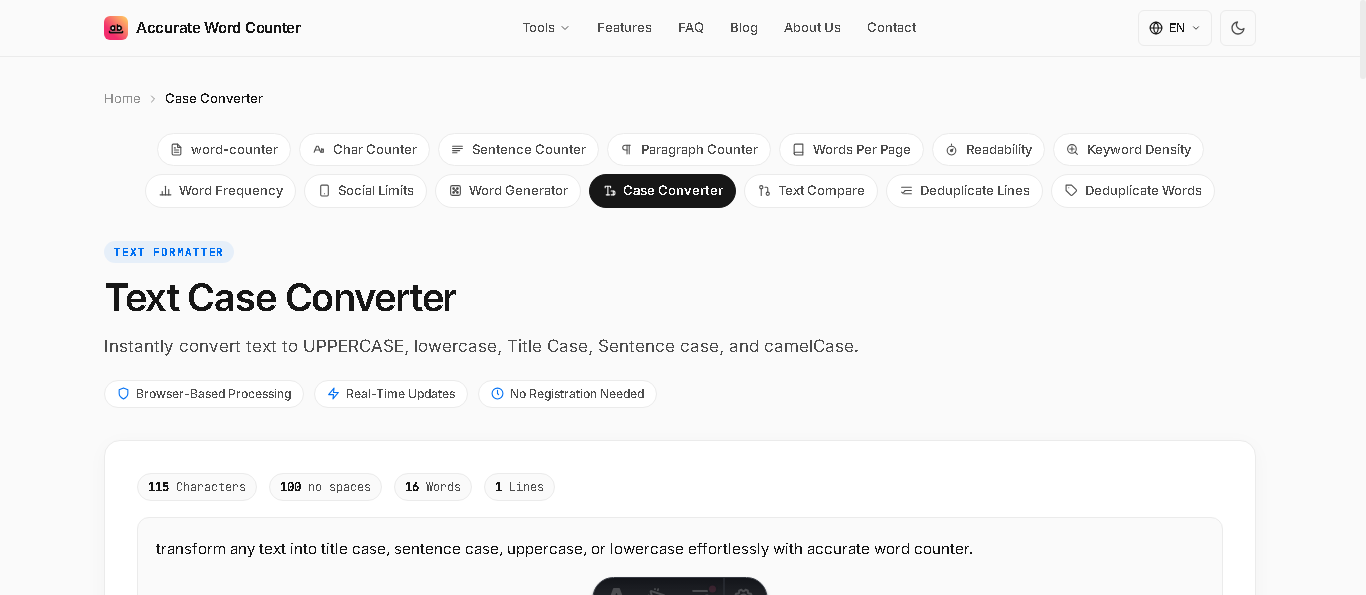
Converting hundreds of titles or changing a paragraph from ALL CAPS into proper title case by hand is tedious. Use our free, client-side Online Case Converter to switch between 10+ capitalization styles, trim extra spaces, and generate clean kebab-case URL slugs with browser-based privacy.
Frequently Asked Questions
What is the main difference between Title Case and Sentence Case?
Title Case capitalizes the first word, last word, and all major words (nouns, verbs, adjectives). Sentence Case only capitalizes the initial word of the sentence and any proper nouns (like names, places, and brands).
Is the word "is" capitalized in Title Case?
Yes, absolutely. Even though "is" is only two letters long, it is a verb (form of "to be"). All verbs are always capitalized in Title Case across AP, Chicago, MLA, and APA styles.
Why do Google and Apple prefer Sentence Case in user interfaces?
Sentence Case offers higher reading legibility, eliminates visual clutter, prevents confusion over brand names versus ordinary capitalized nouns, and translates accurately into foreign languages that do not use title-case capitalization.
What is kebab-case vs snake_case?
kebab-case separates words with hyphens (e.g., "title-case-guide") and is the standard for SEO URLs and HTML/CSS classes. snake_case separates words with underscores (e.g., "title_case_guide") and is standard in Python and database columns.