
Keyword Density in Modern SEO: Ideal Percentage, N-Grams & Avoiding Penalties
What is the ideal keyword density for SEO in 2026? Learn how Google evaluates keyword frequency, how N-grams work, and how to avoid algorithmic over-optimization penalties.
In the early days of search engine optimization, content creation often revolved around a mechanical obsession: repeating a target search phrase as many times as possible to convince search engines of relevance.
The ideal keyword density for SEO content in 2026 is 1.0% to 1.8% for your primary keyword phrase (roughly 10 to 18 mentions per 1,000 words). Exceeding 2.5% to 3.0% risks triggering Google's algorithmic over-optimization and keyword stuffing penalties, while maintaining under 0.5% may fail to signal strong topical focus.
Today, search engines like Google use advanced neural semantic algorithms that understand synonyms, entities, topical depth, and conversational context. So does keyword density still matter? Yes—it serves as your safety rail to ensure topical focus without triggering spam filters.
What is Keyword Density and How is it Calculated?
Keyword density is the percentage of times a keyword or phrase appears within a text relative to the total number of words in the document:
Keyword Density Formula
Density (%) = (Keyword Occurrence Count ÷ Total Word Count) × 100For example: If your target phrase appears 15 times in a 1,500-word article, your keyword density is exactly 1.0%.
What is the Ideal Keyword Density Range for Modern SEO?
The universally recognized sweet spot for primary keywords across competitive search queries is 1.0% to 1.8%.
Anything above 2.5% to 3.0% enters the danger zone of keyword stuffing, which triggers algorithmic over-optimization penalties and degrades user readability.
| Article Length (Words) | Safe Occurrence (1.0% – 1.5%) | Upper Bound (1.8% – 2.0%) | Danger Zone (Over-Optimization) |
|---|---|---|---|
| 500 words | 5 – 7 times | 9 – 10 times | 12+ times |
| 1,000 words | 10 – 15 times | 18 – 20 times | 25+ times |
| 1,500 words | 15 – 22 times | 27 – 30 times | 35+ times |
| 2,000 words | 20 – 30 times | 36 – 40 times | 45+ times |
| 3,000 words | 30 – 45 times | 50 – 60 times | 70+ times |
Understanding N-Gram Phrase Analysis
Modern SEO is rarely about single, isolated words. Search queries are multi-word phrases. That is why professional content strategists examine N-grams:
- 1-Gram (Single Word): Evaluates individual words (e.g., "coffee", "roast", "beans"). Useful for verifying thematic vocabulary.
- 2-Gram (Two-Word Phrase): Identifies pairs (e.g., "espresso machine", "cold brew"). Most natural search phrases fall here.
- 3-Gram (Three-Word Phrase): Identifies long-tail structures (e.g., "best espresso machine", "how to roast").
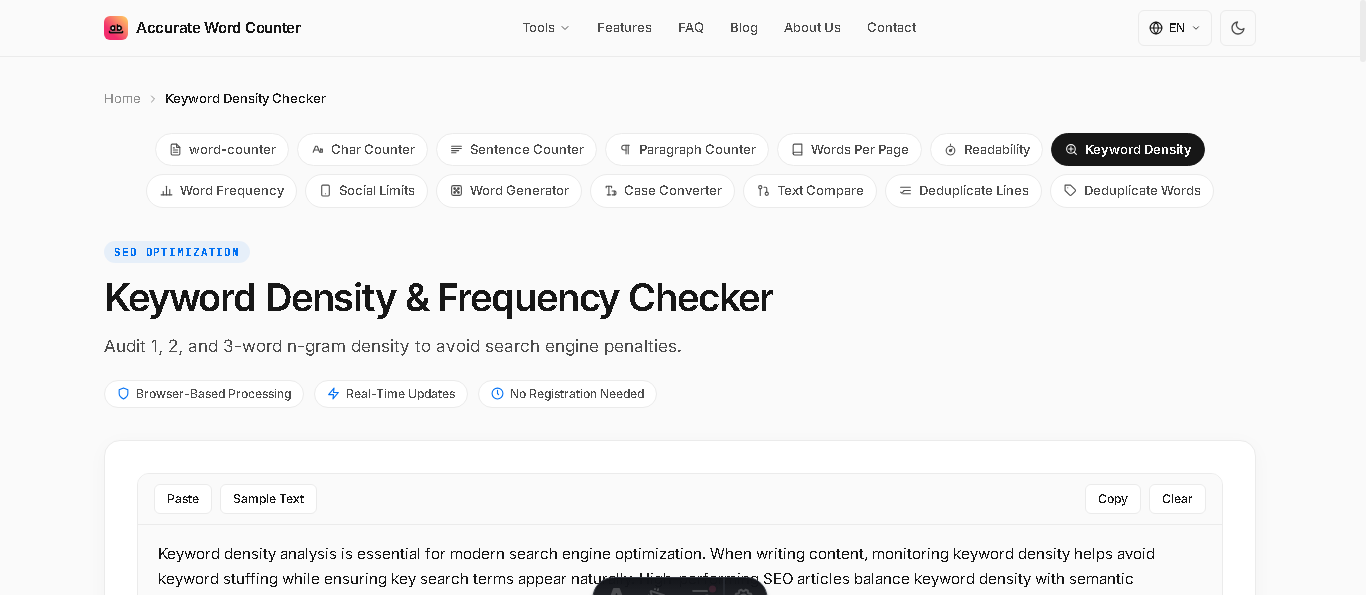
By checking 2-gram and 3-gram densities, you can confirm whether you are addressing the specific subtopics searchers expect without repeating the exact same sentence verbatim. You can filter and inspect these in our free Keyword Density Checker.
Best Practices for Natural Keyword Placement
Rather than scattering keywords arbitrarily across every paragraph, position them in high-weight semantic HTML locations:
- The Title Tag (`<title>`): Place your primary target near the front of the tag.
- The Main Heading (`<h1>`): Clear, compelling, and aligned with user intent.
- The Opening 100 Words: Confirm to the reader and web crawlers that the page immediately addresses the topic.
- At Least One Subheading (`<h2>` or `<h3>`): Organizes the topical outline.
- The URL Slug: Keep it clean and descriptive (e.g.,
/blog/keyword-density-seo-best-practices). - The Concluding Paragraph: Reiterate the key finding naturally.
Frequently Asked Questions
What is the ideal keyword density for SEO?
The recommended sweet spot is between 1.0% and 1.8% for primary target keywords. This equates to 10 to 18 natural occurrences per 1,000 words across headings, introduction, and body text.
What is considered keyword stuffing in 2026?
Keyword stuffing occurs when a target search term is unnaturally forced into prose, typically exceeding 2.5% to 3.0% density. Google penalizes stuffed pages because it impairs user readability and attempts to manipulate rankings.
What is N-gram analysis in SEO content?
N-grams are contiguous sequences of n words from a text. 1-grams are single words ("word"), 2-grams are two-word phrases ("word counter"), and 3-grams are three-word phrases ("free word counter"). Analyzing N-grams helps identify natural phrase patterns.
What are stop words in keyword analysis?
Stop words are ubiquitous grammatical function words such as "the", "and", "is", "at", and "which". Advanced keyword density checkers filter these out so writers can focus on meaningful topical keywords.