
How to Calculate & Improve Your Flesch Readability Score (Complete Guide)
Learn how the Flesch Reading Ease formula works, what score you should aim for, and 7 proven editing techniques to make your writing clear, engaging, and easy to read.
Whether you are crafting an executive report, drafting a blog post, or preparing an academic paper, writing that feels effortless to read consistently outperforms dense, jargon-laden prose.
To improve your Flesch Readability score immediately: shorten average sentence length to 14–18 words, replace multi-syllabic words with simple everyday alternatives, eliminate passive voice, and break long paragraphs into 2–3 sentence chunks. For modern digital content, aim for a Flesch Reading Ease score of 60 to 70 (equivalent to an 8th–9th grade level).
That is where readability scores become an indispensable editorial compass. By understanding formulas like the Flesch Reading Ease and Flesch-Kincaid Grade Level, you can quantitatively measure how accessible your prose is to your target audience.
What is the Flesch Reading Ease Formula?
Developed in 1948 by linguistic researcher Rudolf Flesch, the Flesch Reading Ease test calculates a numerical score from 0 to 100. Higher scores indicate material that is easy to comprehend, while lower scores reflect complex, specialized, or confusing language.
The mathematical equation relies on two primary variables: sentence length and word length (syllable density):
Flesch Reading Ease Formula
Score = 206.835 - (1.015 × ASL) - (84.6 × ASW)Where ASL = Average Sentence Length (Words ÷ Sentences), and ASW = Average Syllables per Word (Syllables ÷ Words).
Flesch Reading Ease Score Ranges & Target Audiences
What score should you target? For mainstream web publications, marketing campaigns, and informational blogs, aiming for a score between 60 and 70 (8th to 9th grade level) is universally recommended by SEO experts and editorial standards.
| Flesch Score | Grade Level | Reading Ease | Ideal Publishing Medium |
|---|---|---|---|
| 90 – 100 | 5th Grade | Very Easy | Children's books, comics, simple instructions |
| 80 – 89 | 6th Grade | Easy | Everyday conversational newsletters, pulp fiction |
| 70 – 79 | 7th Grade | Fairly Easy | Consumer lifestyle blogs, magazine articles |
| 60 – 69 | 8th – 9th Grade | Standard (Recommended) | Corporate blogs, mainstream news, SEO content |
| 50 – 59 | 10th – 12th Grade | Fairly Difficult | High school textbooks, technical whitepapers |
| 30 – 49 | College / Undergrad | Difficult | Academic journals, medical treatises, case law |
| 0 – 29 | Postgraduate | Very Confusing | Legal contracts, patents, government legislation |
7 Proven Rules to Immediately Improve Readability
1. Shorten Your Average Sentence Length
Sentence length is the single heaviest penalty factor in readability formulas. When a sentence exceeds 25 words, reader comprehension drops sharply. Aim for an average of 14 to 18 words per sentence. If a sentence contains more than two conjunctions (like "and", "but", "because"), split it into two independent thoughts. You can monitor your sentence distribution in our free Sentence Counter.
2. Replace Multi-Syllable Words with Everyday Synonyms
Every extra syllable drags down your Reading Ease score. Whenever possible, swap heavy corporate buzzwords for crisp Anglo-Saxon equivalents:
- Use "use" instead of "utilize"
- Use "help" instead of "facilitate"
- Use "start" instead of "commence"
- Use "show" instead of "demonstrate"
- Use "end" instead of "terminate"
3. Eliminate Passive Voice Constructions
Passive voice introduces unnecessary prepositional phrases and weak auxiliary verbs ("was conducted by", "has been established that"). Active voice clarifies who performs the action and naturally trims 20% to 30% of unnecessary filler words.
4. Purge Nominalizations (Zombie Nouns)
A nominalization occurs when a vibrant verb or adjective is converted into a clunky noun ending in -tion, -ment, or -ance. For example:
- "We carried out an evaluation of the software." → "We evaluated the software."
- "The committee came to an agreement." → "The committee agreed."
5. Format for Mobile Eye Scanning
Readability is visual as well as linguistic. Dense 8-sentence walls of text cause cognitive fatigue on smartphone viewports. Keep your paragraphs to 2 to 4 sentences maximum, and introduce bullet lists, bold keywords, and descriptive subheadings every 250 words.
6. Remove Redundant Filler Phrases
Phrases like "in order to" (just say "to"), "due to the fact that" (say "because"), and "at this point in time" (say "now") inflate word counts without adding meaning. Check our Word Frequency Counter to spot words you repeat too often.
7. Test Your Score in Real Time
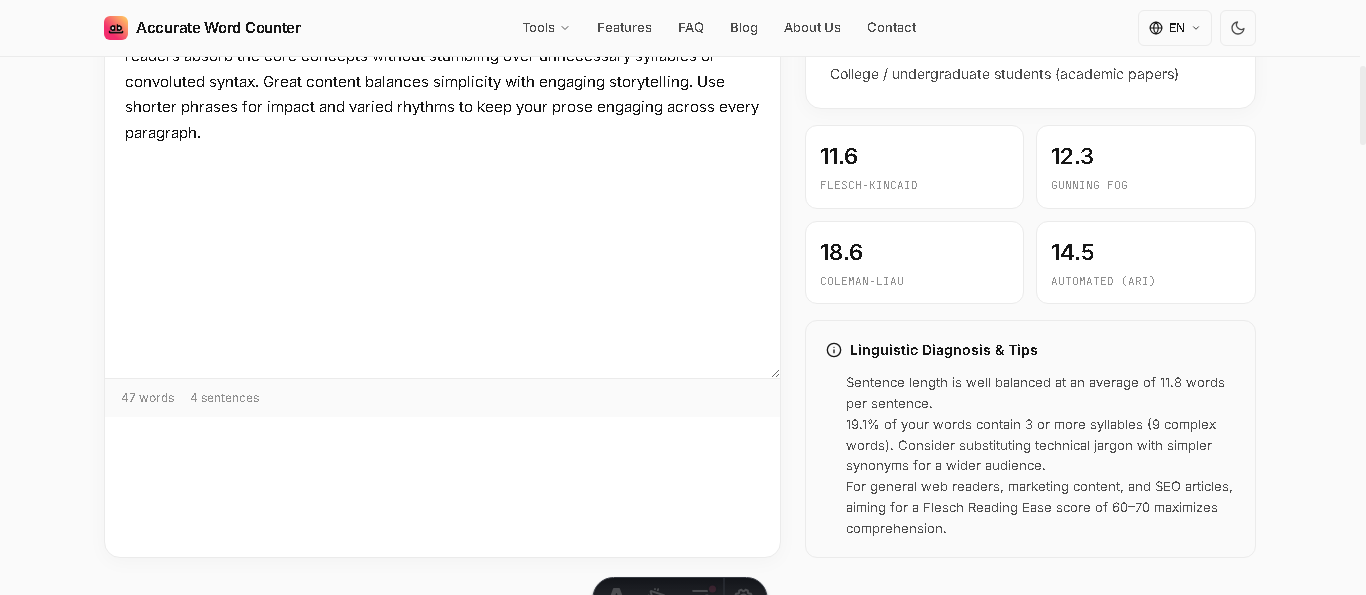
Don't guess how clear your writing is. Paste your work into our client-side Readability Checker to get real-time Flesch Reading Ease, Flesch-Kincaid, Gunning Fog, and automated suggestions with complete privacy.
Frequently Asked Questions
What is a good Flesch Reading Ease score for SEO and blogs?
A score of 60 to 70 (corresponding to an 8th or 9th grade reading level) is considered the ideal benchmark for web articles, blogs, and SEO content, ensuring maximum comprehension across general audiences.
What is the difference between Flesch Reading Ease and Flesch-Kincaid Grade Level?
Flesch Reading Ease outputs a score from 0 to 100 where higher is easier (60–70 is standard). Flesch-Kincaid Grade Level converts this into US school grade equivalents (e.g., 8.0 indicates an 8th-grade reading level).
Does a higher readability score mean "dumbed down" writing?
No. High readability means syntactic clarity and cognitive efficiency. Renowned authors like Ernest Hemingway consistently scored in the 70–80 range. Clarity allows sophisticated arguments to be understood without friction.
How does Google view readability in ranking content?
While readability formulas are not direct algorithmic ranking factors, user engagement metrics like dwell time, low bounce rates, and task completion heavily favor content that visitors can digest immediately without cognitive fatigue.