
How Many Sentences in a Paragraph? Rules for Web, Academic & Essay Writing
Discover the ideal number of sentences for paragraphs across academic essays, digital web articles, fiction, and business reports. Includes PEEL structure and mobile rules.
One of the most frequent questions writers of all levels ask is: "How many sentences belong in a single paragraph?"
In academic essays and formal papers, a paragraph typically contains 4 to 7 sentences (100–200 words) to thoroughly develop a thesis point. In modern web writing and SEO articles, paragraphs should be kept to 1 to 3 sentences (30–80 words) to avoid intimidating mobile readers. Ultimately, a paragraph is defined by a single unified idea rather than a rigid sentence quota.
The classic rule taught in grade school was "five sentences." But in professional writing, the truth is far more flexible. Depending on whether you are writing an academic dissertation, a mobile-first blog post, a legal brief, or a narrative novel, expected paragraph length changes drastically.
Paragraph Length by Publication Medium
| Medium / Genre | Typical Sentence Count | Typical Word Count | Primary Purpose |
|---|---|---|---|
| Digital Web / Blogs | 1 – 3 sentences | 30 – 80 words | Fast visual scanning, high mobile dwell time |
| Academic Essays / Thesis | 4 – 7 sentences | 120 – 250 words | Rigorous topic defense, evidence citation, synthesis |
| Email & Marketing Copy | 1 – 2 sentences | 20 – 50 words | Urgent calls-to-action, high click-through rates |
| Journalistic News (AP Style) | 1 – 2 sentences | 35 – 60 words | Inverted pyramid clarity, neutral reporting |
| Fiction & Creative Prose | 1 – 8 sentences (fluid) | 10 – 300 words | Dialogue pacing, atmospheric buildup, character voice |
1. Academic Writing: The Classic PEEL Structure (4 to 7 Sentences)
In high school, college essays, and academic research papers, professors expect structured paragraphs that develop an argument thoroughly. The standard framework is the PEEL method:
- Point (1 sentence): Introduce the core claim or topic sentence.
- Explanation (1–2 sentences): Expand on the claim and define terms.
- Evidence (1–2 sentences): Present supporting data, historical facts, or direct textual quotes.
- Link (1 sentence): Connect the evidence back to your overarching thesis or transition to the next point.
Following this structure naturally produces paragraphs containing 100 to 200 words. Anything shorter often feels underdeveloped to an academic evaluator.
2. Modern Web Writing: The 1-to-3 Sentence Rule
On the internet, reading behavior is completely different. Over 60% of web traffic originates on mobile devices with narrow 375px to 420px viewports. A 150-word academic paragraph becomes a monolithic "wall of text" that fills an entire phone screen, triggering visual intimidation and immediate bounces.
Web content best practices dictate:
- Limit paragraphs to maximum 3 sentences.
- Allow important punchlines and key takeaways to stand alone as single-sentence paragraphs.
- Use descriptive subheadings every 2 to 3 paragraphs to guide the reader's eye.
3. Can a Paragraph Consist of Just One Sentence?
Yes, absolutely.
Single-sentence paragraphs are extremely powerful in modern English. They create dramatic emphasis, isolate unforgettable truths, and reset the reader's cognitive cadence. While you should avoid stringing twenty single-sentence paragraphs together like a shopping list, deploying one at a pivotal narrative turn is an elite stylistic device.
4. How to Audit and Balance Your Paragraph Lengths
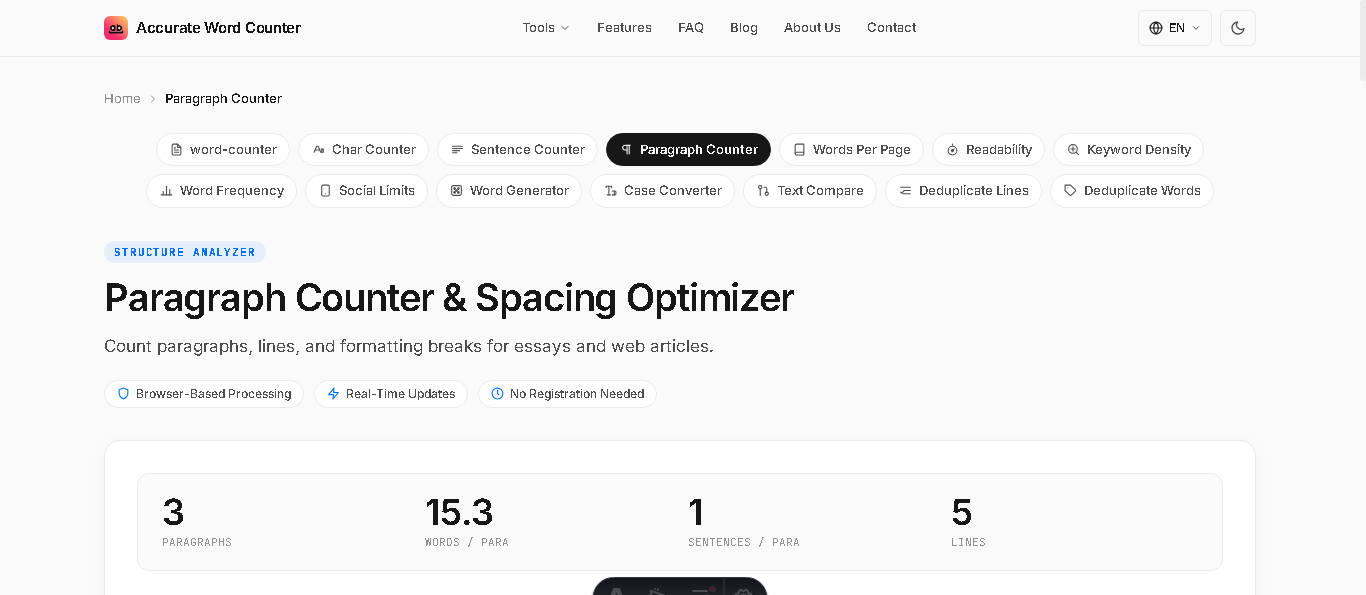
To verify that your writing strikes the right balance between intellectual depth and visual breathing room, test your text in our free Online Paragraph Counter & Formatter:
- Paste your article or manuscript into the editor.
- Inspect the Average Words per Paragraph: Web articles should average under 65 words; academic papers should average 120–180 words.
- Check your Longest Paragraph card: If any paragraph exceeds 250 words, consider splitting it at the primary conjunction.
- Use our one-click formatters to clean extra empty blank lines or normalize paragraph indentations automatically.
Frequently Asked Questions
How many sentences should be in a standard paragraph?
In academic essays, paragraphs typically contain 4 to 7 sentences (100–200 words) using the PEEL method. In digital blogs and online articles, paragraphs should be 1 to 3 sentences (30–80 words) for effortless mobile reading.
Can a paragraph be just one sentence long?
Yes, absolutely. Single-sentence paragraphs are widely accepted in journalism, creative writing, and digital copywriting to create dramatic emphasis, highlight key takeaways, and improve visual cadence.
Is a 10-sentence paragraph grammatically incorrect?
No, there is no strict grammatical rule restricting paragraph length in English as long as all sentences revolve around a single unified idea. However, paragraphs longer than 8 sentences frequently cause reader fatigue and high bounce rates on digital screens.
What is the PEEL paragraph structure in academic writing?
PEEL stands for Point (topic claim), Explanation (unpacking the concept), Evidence (supporting data or citation), and Link (connecting back to the central thesis or transitioning to the next paragraph).